A 15-Minute Morning Yoga Routine to Wake Up Calm and Energized
This is for anyone who wants a morning yoga routine they can actually do before work, not a 60-minute flow that only happens on vacation. Below is the exact 15-minute sequence I teach, pose by pose, with breath counts and timing, plus a 5-minute version for rushed mornings and a 25-minute version for slow ones. You do not need to be flexible, and you do not need to be a morning person. You need a mat, a little floor space, and about the time it takes to make coffee.
Why mornings work (and why you feel so stiff)
First, the stiffness is normal. You have been lying nearly still for seven or eight hours, your joints have not moved through their ranges, and the tissue around your spine is at its least pliable point of the day. Morning stiffness is not a sign that you are bad at yoga. It is a sign that you just woke up.
That is exactly why the routine below starts on the floor, moves slowly, and saves deeper stretching for the back half. Do not fold straight into a deep hamstring stretch at 6:15 a.m. Warm the spine first with gentle movement, then ask for more.
Mornings work for a few practical reasons too. Nothing has gone wrong yet, so your energy is uncomplicated. The practice is done before the day can cancel it. And a quiet 15 minutes of breathing and moving before you check your phone changes how you walk into everything after it. Plenty of my students are not morning people. The sequence is built so you do not have to be.
Set up the night before
The biggest predictor of whether morning yoga happens is whether the mat is already out. Unroll it before bed in a spot you will walk past. Put a glass of water next to it. If you like a candle or a plant in the corner, great, but a clear patch of floor by a window is more than enough. If you want to build a corner that genuinely makes you want to practice, I wrote a whole guide to the yoga aesthetic at home and how to keep it from turning into a shopping project.
A few other notes before you start:
- Practice on an empty stomach or after a few sips of water. Coffee can wait 15 minutes, or come first if that is non-negotiable for you. Both are fine.
- Keep your phone out of the room, or in airplane mode if you use it as a timer.
- If any of these poses are brand new to you, read through the pose cues in my beginner yoga plan for home first so the names below make sense.
- If you are pregnant, recovering from an injury, or have back or knee pain, check with your doctor or physical therapist before starting, and skip anything that hurts.
The 15-minute morning yoga routine
Move at the pace of your breath, not the pace of a video. Inhale and exhale slowly through the nose. When I give a count like “inhale for four, exhale for six,” count silently and let the numbers slow you down. The times add up to 15 minutes, but a minute either way does not matter.
Seated breathing (1 minute)
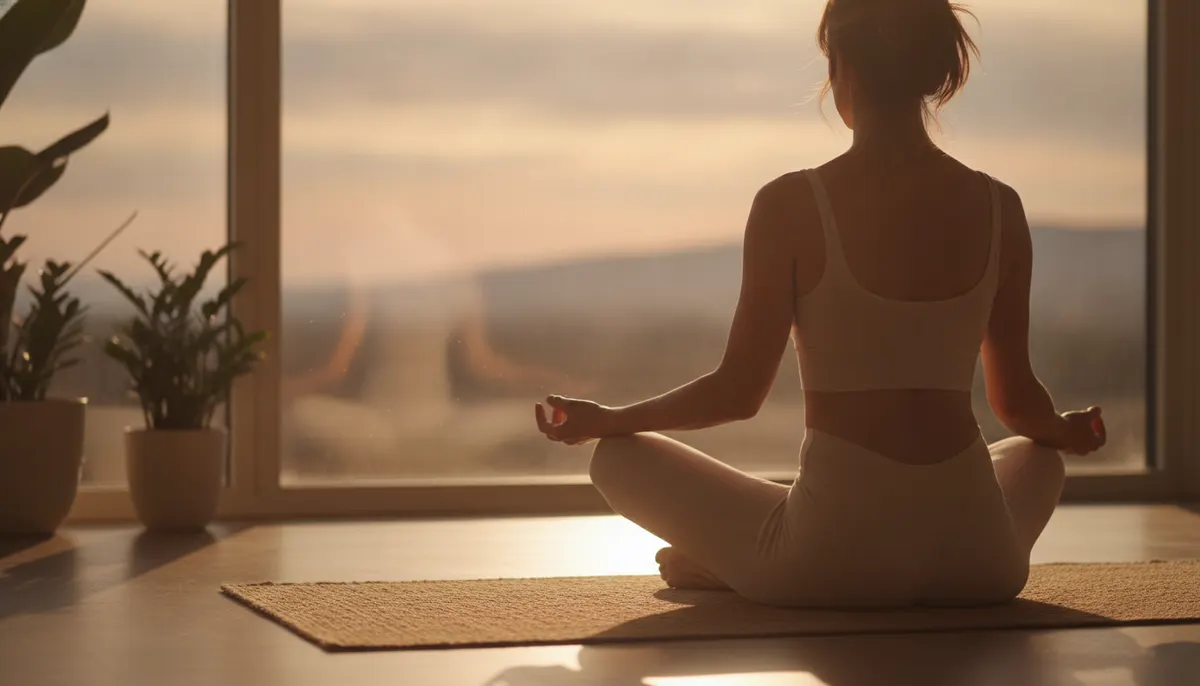
Sit cross-legged on the mat, or on a folded blanket if your knees sit higher than your hips. Rest your hands on your thighs, close your eyes, and take six slow breaths: inhale for a count of four, exhale for a count of six. Let the exhale be longer than the inhale. This sets the pace for everything that follows.
Seated side bends and neck release (1 minute)
Still seated, inhale your right arm up and over to the left, left hand on the floor beside you. Hold for three breaths and feel the right side of your ribs open. Switch sides. Then drop your right ear toward your right shoulder for three breaths, and repeat on the left. Keep both sit bones heavy on the mat.
Cat-cow (1.5 minutes)
Come to hands and knees, wrists under shoulders, knees under hips. Inhale and let your belly drop as your chest and tailbone lift (cow). Exhale and round your spine toward the ceiling, chin tucking (cat). Move through 8 to 10 slow rounds. Press the floor away through your hands so your shoulders do not collapse.
Thread the needle (1 minute)
From hands and knees, inhale your right arm up toward the ceiling, then exhale and slide it under your left arm, lowering your right shoulder and ear to the mat. Hold for four breaths. Unwind on an inhale and repeat on the left. This is the gentle spinal twist that makes the rest of the morning feel looser.
Downward dog with pedaling feet (1.5 minutes)
Tuck your toes and lift your hips up and back. Bend your knees generously at first and pedal one heel down at a time for about 30 seconds, letting the calves and hamstrings wake up. Then settle into a still downward dog for five breaths. Prioritize a long spine over straight legs; bent knees with a long back beat straight knees with a rounded one.
Low lunge and half split, both sides (3 minutes)
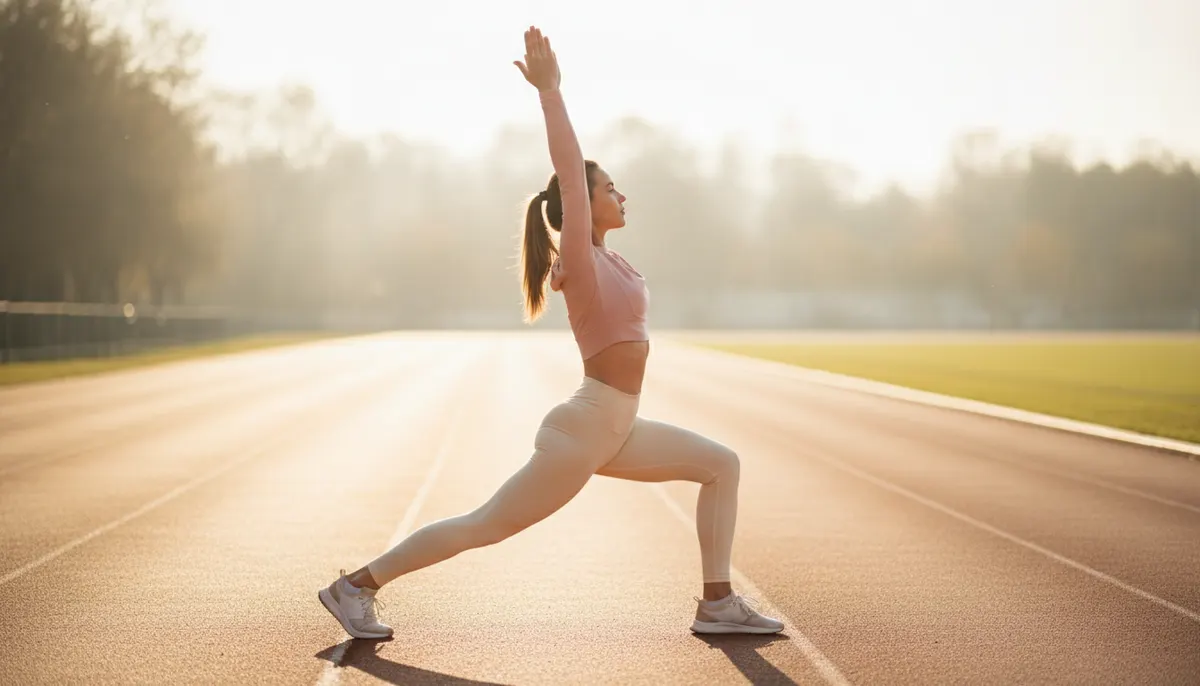
Step your right foot forward between your hands and lower your left knee to the mat (pad it with a blanket if it is sensitive). Inhale your arms overhead and hold for five breaths, letting the hips sink forward without the front knee drifting past the ankle. Then shift your hips back over the left knee, straighten the right leg, flex the foot, and fold over it for four breaths. Return to downward dog and repeat on the left side.
This pair is the heart of the routine. Hip flexors shorten from sitting and from sleeping curled up, and the hamstrings follow, so this is where most people feel the biggest change by the end of the first week.
Three slow sun salutations (3 minutes)
From downward dog, walk your feet to your hands and roll up to standing. Then move through three rounds of a simple sun salutation, one breath per movement:
- Inhale, reach the arms overhead.
- Exhale, fold forward with soft knees.
- Inhale, lift halfway, hands to shins, back flat.
- Exhale, step back to a high plank and lower to the floor (knees down is a smart choice in the morning).
- Inhale, cobra: press the tops of the feet down and lift the chest a few inches.
- Exhale, press back to downward dog and stay for three breaths.
- Walk the feet forward, inhale to lift halfway, exhale to fold, inhale to rise all the way up.
Take each round a little bigger than the last. The first one is a test. The third one should feel like you have arrived.
Chair pose and ragdoll fold (1.5 minutes)
Stand with feet hip-width apart, sit your hips back as if into a chair behind you, and reach your arms forward or up. Hold for five breaths, weight in your heels, knees tracking over the middle toes. Then straighten the legs, fold forward, hold opposite elbows, and let your head hang heavy for five breaths. Repeat the chair once more. This is the energized half of the title: the legs are the biggest muscles you own, and getting them working tells your whole system the day has started.
Mountain pose and a final breath (1.5 minutes)
Roll up to standing one vertebra at a time. Stand tall, feet grounded, shoulders soft, and sweep your arms overhead on an inhale. Take five slow breaths here, then lower the hands to the heart and take three more with your eyes closed. If you want to set an intention for the day, this is the moment. If you just want to notice that you feel better than you did 15 minutes ago, that counts too.
The 5-minute version for rushed mornings
Some mornings you have five minutes and no more. Five minutes done is worth more than 15 minutes planned. Here is the short version:
- Cat-cow, 8 rounds (1 minute)
- Downward dog, pedaling then stillness (1 minute)
- Low lunge, 4 breaths per side (1 minute)
- One slow sun salutation (1 minute)
- Mountain pose, arms overhead, 5 breaths (1 minute)
Skip the seated breathing and the half split. Keep the long exhales. You still get the spine, the hips, and the legs, which is most of what you came for.
The 25-minute version for slow mornings
On a weekend, or a day you wake early, do the full 15-minute sequence and add the following after the sun salutations, before chair pose:
- Warrior II to reverse warrior, 5 breaths each, both sides (2 minutes). Front knee bent over the ankle, back foot parallel to the short edge of the mat, arms reaching long. For reverse warrior, flip the front palm and reach it up and back.
- Figure-four or pigeon, 8 breaths per side (3 minutes). Lying on your back, cross the right ankle over the left thigh and hug the left leg in. If pigeon is comfortable for your knees, take it from downward dog instead.
- Bridge pose, two rounds of 5 breaths (1.5 minutes). Feet flat, press through the heels, and let the hips rise. Keep the knees pointing forward.
- Supine twist, 5 breaths per side (1.5 minutes). Knees to one side, gaze to the other.
Then finish with chair pose and mountain as before, and add two minutes lying flat in savasana with your eyes closed, which brings the total to 25. I know savasana in the morning sounds like a trap. It is not. A short rest after movement is when the calm half of the title actually lands.
How to make morning yoga a habit
The routine is not the hard part. Doing it on a Tuesday in November is the hard part. A few things that genuinely help:
Attach it to something you already do. Put the mat between the bed and the coffee maker, and do the practice between those two actions. Habits stick when they have an anchor, and “right after I get up” is the most reliable anchor there is.
Start with the 5-minute version for the first two weeks. The goal of the first two weeks is to show up, not to finish. Once showing up is automatic, lengthen the practice.
Lower the bar on bad days. Cat-cow and three breaths in mountain pose is a practice. A streak that survives bad days is worth more than a perfect week followed by a month off.
Track it somewhere you can see. A check mark on a paper calendar is enough. Nobody needs another app.
Talk to yourself the way you would talk to a friend. If you miss a morning, you did not fail. You missed a morning. The mat is still there tomorrow.
These are the same principles I use for every other healthy routine, and I go deeper into them in my guide to turning health goals into lifelong habits. The short version: make it small, make it obvious, and give yourself a break.
The connection between morning movement and better sleep
This surprises people: one of the best things I know for sleep is a consistent morning. A regular wake time, a little movement, and some daylight soon after waking help anchor your body clock, and when your body knows when the day starts, it has a much better idea of when the day should end. Research on sleep consistently supports the same thing: regularity in the morning makes it easier to feel sleepy at night.
It works the other way too. If you are short on sleep, this routine will feel harder, your balance will be worse, and your motivation to roll out the mat will be lower. I wrote about how lack of sleep quietly derails fitness goals, and morning yoga will not undo a five-hour night. Treat the two as partners: an earlier, calmer evening makes the morning practice possible, and the morning practice makes the evening calmer.
If evenings are where your mind races, keep this routine energizing and save the slow, long-hold work for the end of the day. Morning yoga is meant to wake you up, not wind you down.
Questions I get about morning yoga
Should I do this before or after coffee? Whichever gets you on the mat. Caffeine on an empty stomach makes some people jittery during the breathing parts, so if you can wait, try waiting. If you cannot, drink the coffee.
I am so stiff I cannot touch my toes. Is this routine for me? Yes, more than for anyone. Bend your knees as much as you need to in every fold. Toe touching is not the point and never was.
Is 15 minutes enough to count as exercise? It is enough to count as movement, mobility, and breathing practice, which are the things most of us are missing. If you want strength and conditioning, pair it with your other training. Morning yoga makes that training feel better.
What if I only manage it three days a week? Three days a week, every week, beats seven days for one week and then nothing. Pick your three and protect them.
Where to go next
When the day leaves you wound up instead of calm, my 20-minute calming yoga sequence for stress and anxiety is the evening bookend to this routine: slower, longer holds, and breathing you can take to bed. And if you want to see where a protected 15 minutes fits into a whole day, my realistic self-care routine for busy women is built around exactly this kind of small, non-negotiable block.