Yoga for Stress and Anxiety: Poses, Breathing, and a 20-Minute Sequence
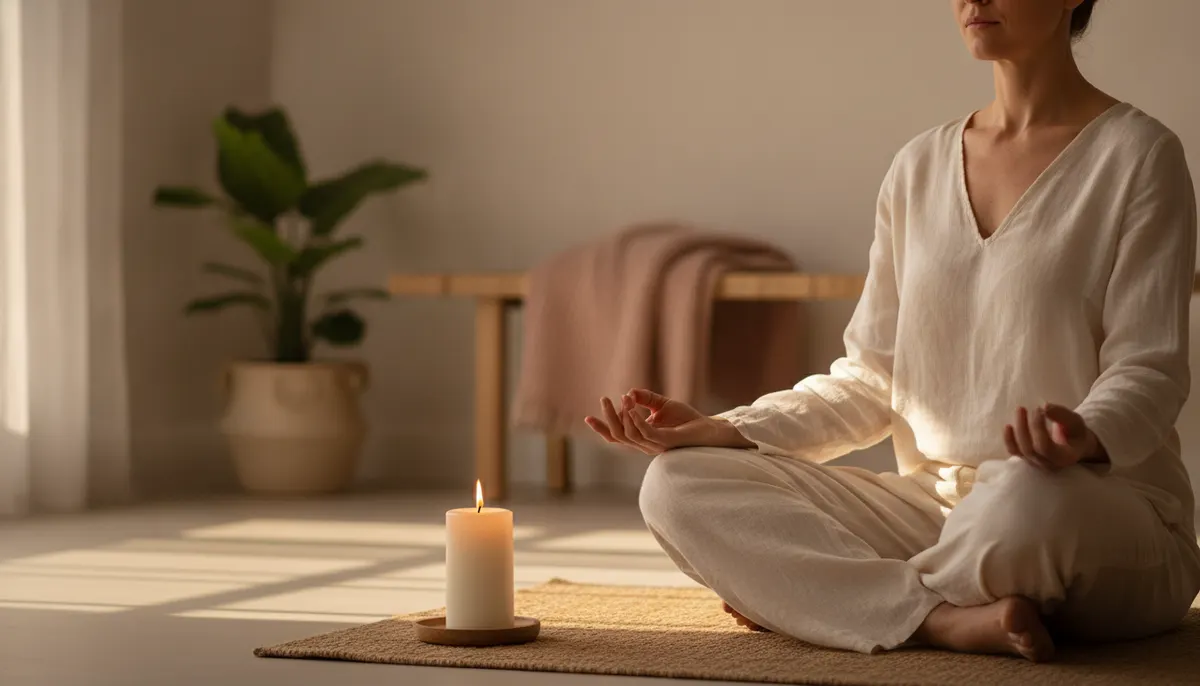
If your mind runs at full speed from the moment you wake up, or you carry stress in your shoulders and jaw until bedtime, this is for you. You will get three breathing exercises with exact counts, eight calming yoga poses with how long to hold them, and a 20-minute evening sequence that puts them together. I will also be honest about when to practice, what yoga can and cannot do for anxiety, and the point at which it is time to talk to a professional. No flexibility required, and no experience either.
Why slow movement and breath calm you down
Your nervous system has a gas pedal and a brake. The gas pedal (the sympathetic side) gets you ready to deal with a threat: faster heart rate, shallow breathing, tight muscles, a mind that scans for problems. The brake (the parasympathetic side) handles rest, digestion, and recovery. Anxiety, in plain terms, is the gas pedal stuck down when there is nothing to run from.
You cannot think your way off the gas pedal. You can breathe your way off it. A long, slow exhale is one of the few parts of the stress response you control directly, and research consistently shows that slow breathing lowers heart rate and the feeling of being on edge. Gentle movement adds a second signal: muscles that lengthen and relax tell the brain the emergency is over. Attention is the third signal. When you are tracking the sensation in your hamstrings, you are not rehearsing tomorrow’s meeting.
Yoga is simply all three signals at once: breath, movement, attention. It will not cure anxiety, and anyone who tells you it will is selling something. What it reliably does is change the next 20 minutes, and with practice, it changes your baseline.
I came to yoga for the way it looked, honestly, and I have written about how I went from the aesthetic to the actual practice. The part that kept me was this part: noticing, on an exhale, how much I had been holding, and learning that I could put it down.
Three breathing exercises for anxiety
Breathing is the fastest tool here, and the one you can use at your desk, in the car, or at 3 a.m. Sit or lie down, breathe through your nose, and let the belly and lower ribs move. If any of these make you dizzy or more anxious, stop and breathe normally; next time, drop any holds and shorten the counts.
Extended exhale (the one to learn first)
Inhale through your nose for a count of four. Exhale through your nose, or through softly pursed lips, for a count of six. Repeat for two to five minutes. Once six feels easy, lengthen the exhale to eight while the inhale stays at four.
The exhale is where the calm lives. Nothing else about this needs to be perfect. If counting feels stressful, just make each exhale a little longer than the inhale and let the numbers go.
Box breathing (for a racing mind)
Inhale for four counts. Hold for four. Exhale for four. Hold empty for four. That is one round; do eight rounds, about two and a half minutes. The holds give a racing mind something to do, which is why this works well before a presentation or a hard conversation.
Skip the holds if you are pregnant, if you have blood pressure concerns, or if holding your breath makes you feel trapped. A plain four-in, six-out breath does most of the same work.
Alternate nostril breathing (for settling before sleep)
Sit tall. Rest your left hand on your knee. With your right hand, fold the index and middle fingers toward your palm so your thumb and ring finger are free. Close your right nostril with your thumb and inhale through the left for a count of four. Close the left nostril with your ring finger, release the thumb, and exhale through the right for six. Inhale through the right for four. Close it, release the left, and exhale through the left for six. That is one round. Do five to ten rounds, and finish with a few normal breaths.
It is slower and more fiddly than the other two, and that is the point: the coordination pulls your attention fully into the breath. Skip it when you are congested.
Eight calming yoga poses (and how long to hold them)
These are all floor-based or supported, held long enough for the nervous system to get the message. Grab a pillow, a folded blanket, and a wall. Keep the extended exhale going in every pose.
Child’s pose
Kneel, big toes together, knees wide, and fold forward with your forehead on the mat or a pillow and your arms stretched forward or resting back by your feet. Hold for 1 to 3 minutes. Cue: let your belly rest on your thighs and breathe into your back ribs. If your knees complain, put a blanket between your calves and thighs.
Cat-cow
On hands and knees, inhale to drop the belly and lift the chest; exhale to round the spine and tuck the chin. Move slowly through 8 to 10 rounds. Cue: let the breath lead and the spine follow, not the other way around. This is the one to do first when you are too wired to be still.
Ragdoll forward fold
Stand with feet hip-width apart, bend your knees generously, and fold forward, holding opposite elbows and letting your head hang. Hold for 1 minute, swaying gently if that feels good. Cue: nod yes and shake no with your head to release the neck. Come up slowly, one vertebra at a time.
Seated forward fold
Sit with legs extended, a pillow on your shins or thighs, and fold forward until your forehead or chest rests on the pillow. Hold for 2 minutes. Cue: round the back and bend the knees as much as you need; this is a resting shape, not a hamstring stretch. Supporting the head is what makes it calming rather than effortful.
Supported bridge
Lie on your back, knees bent, feet flat. Lift your hips and slide a yoga block, a firm pillow, or a stack of books under your sacrum (the flat bone at the base of your spine, not your lower back). Rest your weight on the support with your arms by your sides. Hold for 2 minutes. Cue: let the hips be heavy on the prop; you are not holding yourself up.
Reclined butterfly
Lie on your back, soles of the feet together, knees falling open, with a pillow under each knee so the inner thighs can let go. One hand on the belly, one on the chest. Hold for 2 to 3 minutes. Cue: feel the belly rise under your hand on each inhale and fall on each exhale. If your lower back aches, slide a folded blanket under your hips.
Supine twist
Lie on your back, hug your knees in, then let both knees fall to the right, arms open wide, gaze to the left. Hold for 1 to 2 minutes, then switch sides. Cue: a pillow under the knees makes this fully restful; the knees do not need to reach the floor.
Legs up the wall
Sit sideways against a wall, swing your legs up it, and lie back with your hips a few inches from the wall and your arms wherever they are comfortable. Hold for 3 to 5 minutes, or longer. Cue: this is the single most calming shape I know, and the one I recommend when someone tells me they cannot “do” meditation. You do not have to do anything. Just stay.
The 20-minute evening yoga sequence for stress
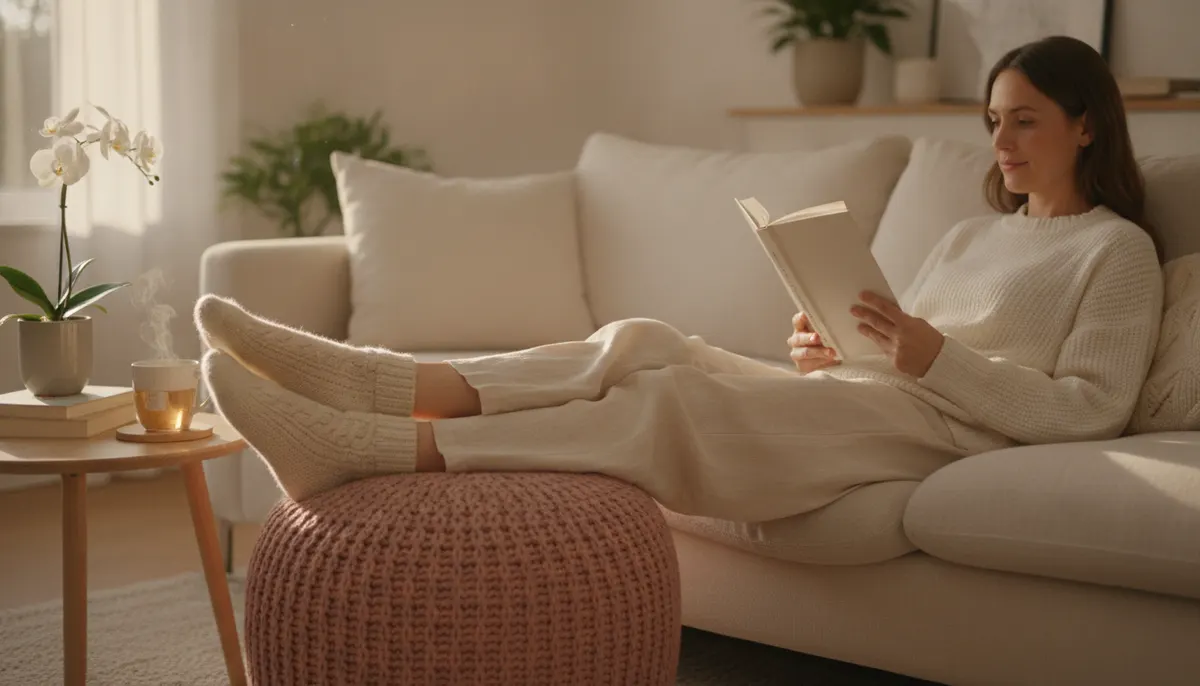
Do this 30 to 60 minutes before bed, lights dimmed, phone in another room. You will need a pillow and a blanket, and a wall for the end. Breathe with the extended exhale throughout: four in, six out.
- Seated or lying extended exhale breathing (2 minutes)
- Cat-cow, 8 to 10 slow rounds (2 minutes)
- Child’s pose (2 minutes)
- Ragdoll forward fold (1 minute)
- Seated forward fold on a pillow (2 minutes)
- Supported bridge (2 minutes)
- Supine twist, 1 minute per side (2 minutes)
- Reclined butterfly (2 minutes)
- Legs up the wall (3 minutes)
- Savasana: lie flat, blanket over you, and let the breath go natural (2 minutes)
A few notes. The order matters: the moving shapes come first to burn off restlessness, and the still shapes come once you are able to be still. If you fall asleep during legs up the wall, that is a success, not a failure, but set a soft alarm so you do not wake at 2 a.m. with numb legs. And if 20 minutes is not available, do the breathing, child’s pose, and legs up the wall. That trio takes under ten minutes and still works.
When to practice (and when to do something else)
In the evening is where the full sequence belongs. It is the natural way to end a day that has had your gas pedal down since morning, and it sets up sleep.
In the morning, if anxiety greets you before your feet hit the floor, do two minutes of extended exhale before you get out of bed. Keep any morning movement on the energizing side; long restorative holds first thing can leave you foggy. A shorter, brisker practice suits mornings better, and I point you to one at the end.
During a spike, use the breathing. Two minutes of four-in, six-out in a bathroom stall, a parked car, or a hallway is the most portable tool you have. Nobody needs to know.
And sometimes the right answer is not yoga at all. On some anxious days, long holds feel like being locked in a small room with your own thoughts, and what you actually need is a fast walk, a hard set of squats, or music turned up loud in the kitchen. Choosing movement by how you want to feel afterward, rather than by what you “should” do, is the whole idea behind intuitive movement, and it applies to anxious days more than any other kind. Check in, pick the thing, and let it be different tomorrow.
When yoga is not enough
I want to say this clearly because the wellness world often does not: yoga is a tool, not a treatment. If anxiety is keeping you from sleeping, working, or being with the people you love, if you are having panic attacks, or if you are coping with alcohol or avoidance, please talk to a doctor or a therapist. Breathing exercises are a wonderful supplement to that care and a poor substitute for it.
I spent 14 months in therapy for what I thought was a body image problem. What my therapist helped me see was that it was never about my body; it was anxiety and perfectionism wearing my body as a costume. Yoga did not get me there. A trained professional did, and yoga helped me practice what I was learning between sessions. I still see a counselor. I wrote about the practices that came out of that work in my guide to learning to love your body, and almost all of them are really anxiety practices in disguise.
Yoga teachers are not therapists, including me. If a yoga teacher ever suggests that you should be able to breathe your way out of a clinical condition, find a different teacher.
Small everyday tools that are not yoga
The 20-minute sequence is the anchor. These are the things that keep the baseline lower between practices.
Write it all down. When my mornings started with a racing heart, the thing that helped most was not a pose. It was a list. I put every task on paper with the day I would do it, and the panic turned into a plan; I explain the whole method in how my daily to-do list reduces anxiety. It still works.
Pick one five-minute non-negotiable. Not a whole routine, one thing: the breathing, a walk around the block, legs up the wall. The way to make self-care survive a busy life is to make it small enough that nothing can cancel it, which is the premise of my realistic self-care routine for busy women.
Try the double inhale. Two quick inhales through the nose (the second one tops off the first), then one long exhale through the mouth. One to three rounds. It is the fastest breath reset I know, and it works mid-sentence.
Get outside early. Ten minutes of daylight soon after waking does more for your mood and your sleep than it has any right to. Combine it with the walk.
Name it. “This is anxiety, not danger.” Saying it, even silently, puts a small gap between you and the feeling. Anxiety hates gaps.
Watch the inputs. Caffeine after noon, a phone in bed, and skipped meals all push the gas pedal. None of this is moral. It is just mechanics, and you can adjust the mechanics.
Where to go next
If this sequence helped and you want to build a regular practice around it, my 4-week beginner yoga plan for home teaches the foundational poses with cues and common mistakes, no teacher required. And for the other end of the day, the 15-minute morning yoga routine is the energizing counterpart to this one: same breath, more movement, built to get you out the door calm instead of braced.