Full Body Couples Workout for You and Your S.O.
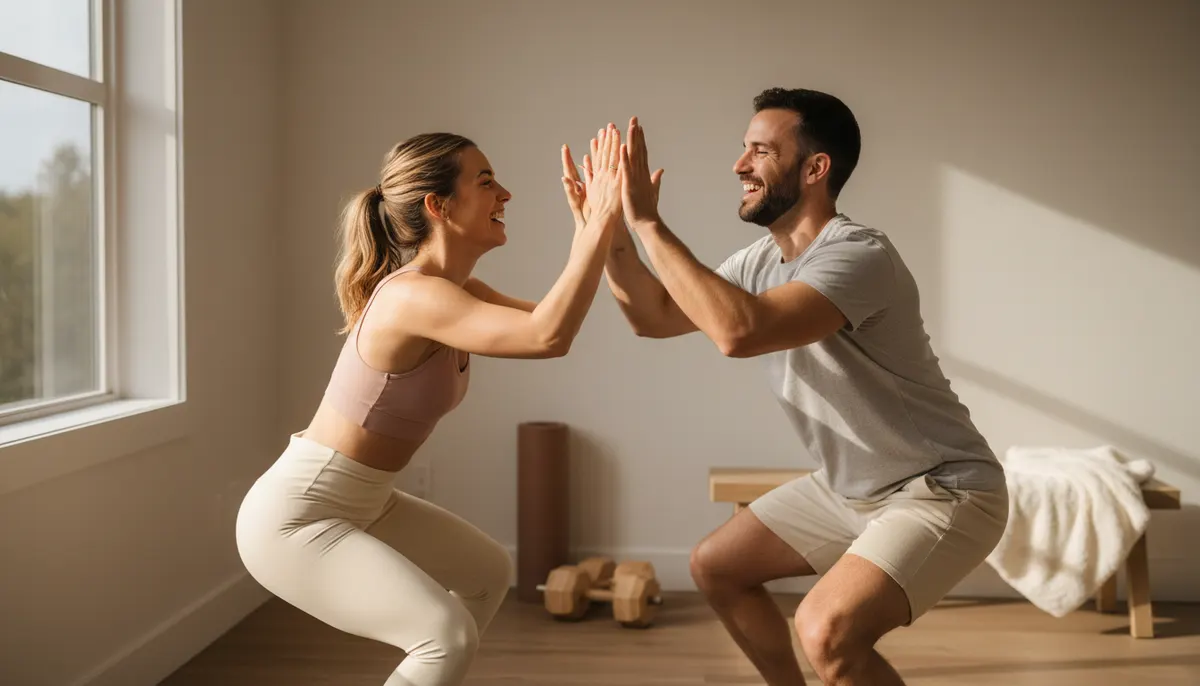
Make a boring workout more fun by grabbing a partner and running through this couple’s workout.
Partner workouts work for a simple reason: you show up for each other. It is harder to skip a session when someone is in your living room holding a medicine ball. Call it a date, put on music you both like, and keep score if you are the competitive type.
You will need a medicine ball (6 to 10 pounds suits most couples; a rolled towel works in a pinch) and floor space for two.
Warm Up Together First
Two or three minutes is enough: 30 seconds of marching in place, 10 bodyweight squats each, 10 arm circles each direction, and 5 slow inchworms (walk your hands out to a plank, then walk your feet back in). You are about to plank, squat, and twist with a partner’s weight involved, so get those patterns moving first.
The Workout
Repeat 3 to 5 times, **10 to 15 reps each. **
- Plank High Fives
- Medball Pass w/ Squats
- Crunch Passes
- Assisted Pistol Squat
- Leg Press
- Partner Leg Drop
- Wheelbarrow Pushup w/ Squats
- Side Plank High Five
A note on reps: pick a number the less experienced partner can finish with good form, and let the stronger partner make each rep harder instead of doing more.
Check out all the exercises below!
Plank High Fives
Get into plank position facing one another. Lift right arms, high five, return to start. Repeat on each side for the intended number of reps.
Setup: Face each other in a high plank about an arm’s length apart, feet a little wider than hip-width for balance.
Partner roles: Equal. You both hold, you both reach.
Reps: 10 to 15 per side.
Key cue: Keep your hips square to the floor as the arm lifts; if you rotate open, widen your feet.
If one of you is stronger: The newer partner planks from the knees; the stronger partner slows each rep to a three count.
Med Ball Pass w/ Squat
Crunching person lays on the ground with a medicine ball in hand. Squatter gets into position. Cruncher lifts up and passes the ball to the squatter, who holds it while the cruncher goes back down and comes back up to retrieve it.
Make it a little hard and have the squatter do a squat each time the cruncher does a crunch.
Setup: The cruncher lies on their back, knees bent, feet flat. The squatter stands at the cruncher’s feet, facing them.
Partner roles: One crunches, one squats and catches. Swap halfway.
Reps: 10 to 15 crunches each.
Key cue: Cruncher, exhale as you sit up and keep your chin off your chest. Squatter, sit back into your heels.
If one of you is stronger: The stronger partner squats with the ball overhead or pauses two seconds at the bottom; the other skips the squat and just catches.
Crunch Passes
Both people lay down flat, arms overhead. One person holds the medicine ball, both crunch up, the ball gets passed and both lay back down. Repeat, passing the ball back and forth and crunching between each pass.
Setup: Lie on your backs, feet toward each other and nearly touching, knees bent, arms stretched overhead on the floor.
Partner roles: Mirror images. You both crunch, and the ball changes hands at the top of every rep.
Reps: 10 to 15 passes.
Key cue: Crunch up with your ribs, not by yanking your arms forward; the ball arrives at the top of the crunch, it does not pull you there.
If one of you is stronger: The stronger partner lowers on a slow three count; the other keeps one hand on the floor for help on the way up.
Assisted Pistol Squat
Assister holds the squatter’s hands as they lower down into a pistol squat. Rise back to the start and repeat for the allotted number of reps. Switch roles and repeat.
Setup: Face each other and hold hands or wrists. The squatter lifts one leg out in front and lowers on the standing leg; the assister stands tall, knees soft, leaning back just enough to counterbalance.
Partner roles: One squats, one anchors. The anchor gives exactly as much help as needed and not an ounce more.
Reps: Work up to 10 per leg; 5 to 8 is a fine start.
Key cue: Squatter, push your knee out over your toes and keep your heel glued down; your partner’s arms are a rail, not a lift.
If one of you is stronger: The stronger squatter uses fingertip contact or a slow four-count lower; the newer squatter lowers to a chair with a full grip.
Couples ask about this one most, so I wrote a full guide to assisted pistol squats and seven other partner squat variations, including the progression from two hands to none.
Leg “Press”
One person lays on the ground while the other leans onto their feet like a weight. The leg presser pushes legs up to straight, repeating until all reps are completed. Switch positions and repeat.
Setup: The presser lies on their back, knees bent, feet flat against the front of the standing partner’s hips (never the stomach). The standing partner holds the presser’s shins lightly and leans in.
Partner roles: One presses, one is the weight, controlling the load by how far they lean.
Reps: 10 to 15 presses each.
Key cue: Presser, keep your lower back on the floor and push through your whole foot. Weight partner, say so before you lean in harder.
If one of you is stronger: This one scales itself: lean in more for a stronger presser, less for a newer one.
Partner Leg Drops
One person lays on the ground and raises legs so a standing person can push them down. Brace core to control the fall and then raise both backs up to be pushed down again. Switch roles and repeat.
Setup: The lying partner holds the standing partner’s ankles and lifts both legs to vertical. The standing partner pushes the legs toward the floor; the lying partner stops them before they touch down and lifts them back up.
Partner roles: One drops and lifts, one pushes. The pusher sets the difficulty (straight down is easier; off to one side is harder).
Reps: 10 to 15 drops each.
Key cue: Lying partner, press your lower back into the floor before every push. If it arches, stop the legs higher.
If one of you is stronger: Push lighter and straight down for the newer partner; push harder or vary the direction for the stronger one.
Wheelbarrow Pushup w/ Squat
One person gets into plank position and a standing person grabs legs. Together, both people go down into pushup and squat, return to start, and repeat.
Setup: The pushup partner sets up in a high plank. The standing partner lifts their legs at the shins, holds them at hip height, elbows tucked.
Partner roles: One pushes up, one squats while holding the legs. Count out loud so you move in rhythm.
Reps: 10 to 15, then switch.
Key cue: Pushup partner, squeeze your glutes so your hips do not sag. Squatter, keep your chest up and the legs close to your body.
If one of you is stronger: Holding the legs at the thighs makes the pushup easier; holding at the ankles makes it harder. The newer partner can also push up from a step.
Side Plank High Five
Both people get into the side plank position, back-to-back. Start with your arm extended into the air, brace your abs and reach down between your arm to high-five the person behind you. Return to start and repeat.
Setup: One of you on your right forearm, the other on your left, backs toward each other with about a foot between you. Stack or stagger your feet and reach your top arm to the ceiling.
Partner roles: Equal. You both hold, you both reach under.
Reps: 10 to 15, then both switch sides.
Key cue: Keep your hips lifted as you thread the arm under; rotate from your ribs.
If one of you is stronger: The newer partner stacks their knees on the floor instead of their feet; the stronger partner lifts the top leg.
Cool Down Together
Finish with five to ten minutes of easy stretching as a pair: a seated forward fold with gentle pressure from your partner, a standing quad stretch holding each other for balance, and a back-to-back seated twist. Talk the whole time and never push past a 7 out of 10. Partner stretching has twelve assisted stretches and a full 10-minute cool-down.
Want something slower for the next date night? Ten beginner-friendly couples yoga poses use the same trust and communication with a lot less sweat.